
Thermometers
Back in my distant childhood, there was no alternative to the mercury thermometer. Nowadays there are at least two: digital and infrared. I'll tell you about every type of thermometer I've personally tested.
A few years ago, after a mercury thermometer broke in our home, I had to spend a long time painstakingly crawling across the floor with a flashlight in my mouth, collecting tiny mercury droplets from every crack in the parquet. After that, the question of buying a safer temperature-measuring device became urgent. By the way, if you ever break a mercury thermometer, you should first read up online about how to neutralize spilled mercury — you'll find out that you must not vacuum it up — and only then proceed to neutralize the hazardous substance.
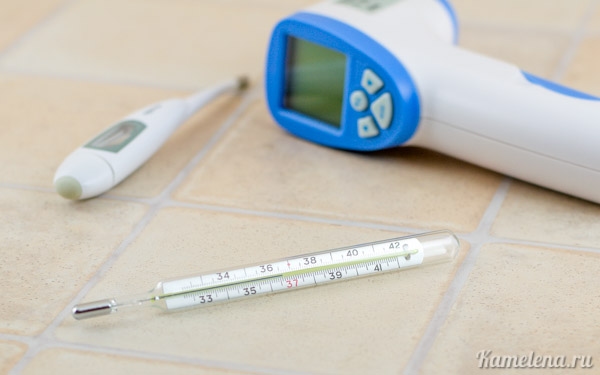
Anyway, the most heavily advertised option was (and still is) the digital thermometer. It's environmentally safe, but that's where its advantages end. The supposedly magical measurement time (about 10 seconds until the beep), regardless of the manufacturer, doesn't match reality at all. A digital thermometer, I would say, measures only a relative temperature — very, very roughly.
In other words, under normal conditions in your armpit, you won't see the coveted 36.6°C after 10 seconds. Moreover, you won't even see it after 3 minutes of measuring. The screen will show your actual body temperature — just like a mercury thermometer — only after about 8–10 minutes (because this thermometer also needs to fully warm up in your armpit for an accurate reading).
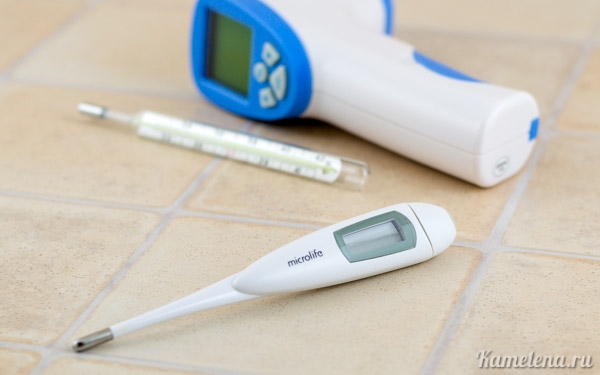
To make sense of the numbers a digital device gives you after, say, 3 minutes, you need to take a series of measurements and work out a rough personal correspondence between the familiar 36.6°C and what the thermometer actually shows (which is roughly 35.8°C after 3 minutes). That would be fine enough, except there's no way to predict what it should read after those same 3 minutes if the patient has a temperature of 38.1°C — you'd need another round of trial-and-error testing.
This state of affairs didn't suit me at all. It's the 21st century, after all, yet we still have to sit for 10 minutes just to take a temperature. Sure, if you're at home, it's a perfectly acceptable way to entertain yourself while sick. However, the day of my daughter Agatha's birth was approaching, and I knew that a newborn would definitely not patiently wait that long with a device tucked in her armpit. So I went looking for a further alternative.
And here it is, our hero — the infrared thermometer:
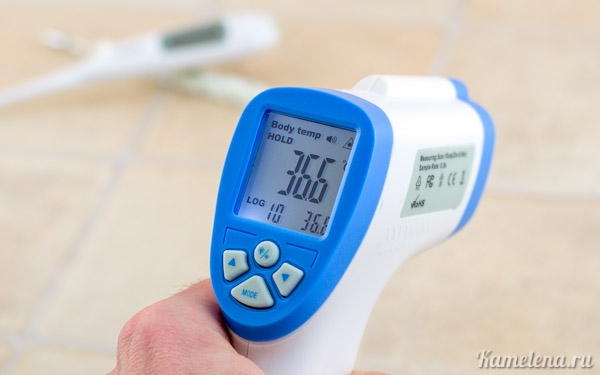
An incredibly convenient device. And most importantly — fast. Temperature measurement takes a maximum of
3 seconds. On top of that, it's contactless, which is great from a hygiene standpoint (I remember how at school during medical check-ups they wiped thermometers with a cotton ball soaked in alcohol). The temperature reading is most accurate when you «shoot» from a distance of 5–15 cm from the target. For routine temperature monitoring, measuring at the temple is sufficient, and if you have doubts, you can always check the armpit as well. The stated margin of error is 0.3 degrees, and there's a calibration function for that. Besides, if you take several readings in a row (which is very quick), a fairly clear picture emerges — the difference between readings is no more than 0.1 degrees.
The thermometer has two measurement modes. You can measure not only body temperature but also the temperature of any surface. That means it works for cooking and for checking the water temperature in the bath when you're bathing a child — though a little floating rubber duck thermometer can double as a toy :)
Oh, I almost forgot — this thermometer costs around $20 on a Chinese website.
Happy measuring, everyone. What thermometers do you use? What's convenient about them, and what isn't? Do you enjoy taking temperatures, or is sitting still for 10 minutes just as unbearable for you as it is for me? :-)
Author: Alexei Khaletsky